

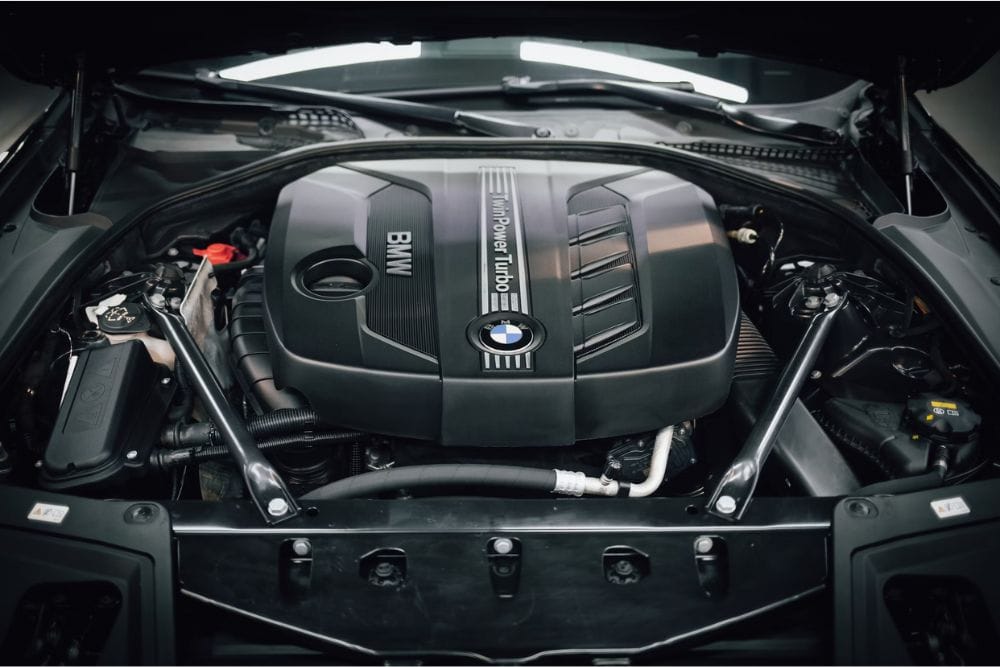
Many BMW petrol engines use an electronic oil level sensor instead of a physical dipstick, so you check the level through the iDrive system with the engine running at operating temperature on level ground.
Other BMWs, including some diesels and certain high-performance models, still have a dipstick, which you check after switching the engine off and waiting for the oil to drain back into the sump.
Either way, checking at least once a month or before long trips helps catch low oil levels early.
Getting an accurate reading depends on following the right conditions for your specific model, and the process is quite different depending on whether your BMW uses a traditional dipstick or an electronic oil level sensor.
This guide covers both methods step by step, explains what BMW’s oil warning messages actually mean, and goes over the oil specifications your BMW needs when topping up.
How Do You Check the Oil Level on a BMW With a Dipstick?
On BMWs with a physical dipstick, you check the oil by parking on flat ground, switching the engine off, waiting for the oil to drain back into the sump, and reading the level on the dipstick between the MIN and MAX marks.
This method gives you a direct, physical reading of the oil level without relying on electronics.
The physical check takes a few minutes plus the waiting time specified in your owner’s manual, and requires nothing more than a clean cloth or paper towel.
Where Is the Dipstick on a BMW?
The dipstick is usually located on the left or right side of the engine bay, depending on the specific model.
It has a brightly coloured handle, often yellow or orange, designed to stand out against the surrounding engine components.
If you are not sure where yours is located, check the owner’s manual for a diagram of the engine bay layout for your specific model.
Not all BMWs have one, so if you cannot find a dipstick handle under the bonnet, your model likely uses an electronic oil level sensor instead.
How Do You Read the Dipstick Correctly?
Park the car on level ground, switch off the engine while it is still warm, and wait for the oil to drain back into the sump.
The exact waiting time varies by model, so check your owner’s manual for the specified interval.
This settling time is important because it gives a more accurate reading of the true oil level, rather than a reading taken while oil is still circulating through the engine.
Once the oil has settled, open the bonnet and pull the dipstick out by its handle.
Wipe it completely clean with a lint-free cloth or paper towel, push it all the way back into its tube, and then pull it out again.
This second pull gives you the reading.
Hold the dipstick horizontally and look at where the oil film ends.
The dipstick has two marks labelled MIN and MAX (or two notches near the tip), and the oil level should sit between these two marks.
Anywhere within that range is acceptable, so there is no need to top up to MAX every time.
If the oil is at or below the MIN mark, add oil before your next drive, following the quantity guidance in your owner’s manual and never exceeding the MAX mark.
What Can the Oil on the Dipstick Tell You About Its Condition?
The colour and texture of the oil can reveal useful information beyond just the level.
Fresh engine oil is typically amber or honey-coloured and slightly translucent.
As oil ages and collects contaminants, it darkens to brown and eventually black, which is normal and does not by itself mean the oil needs changing, as diesel engines in particular can darken oil almost immediately after a fresh change.
Oil condition should be judged by the service schedule rather than colour alone, though abnormal contamination such as metal particles or an unusual smell is worth investigating.
Oil that looks milky, frothy, or has a light brown, creamy appearance could indicate coolant mixing with the engine oil, though moisture from condensation can also cause a similar appearance in engines that are only driven on short trips.
Persistent milky oil warrants investigation by a specialist, as it may point to a head gasket or cooling system issue.
Oil that feels gritty between your fingers may contain metal particles or debris, which is another sign of internal wear that warrants inspection by a specialist.
How Do You Check the Oil Level on a BMW Without a Dipstick?
On BMWs with an electronic oil level sensor instead of a dipstick, you check the oil level through the iDrive infotainment system or the instrument cluster.
The sensor sits in the oil pan and measures the oil level while the engine is running at operating temperature.
Many BMW petrol engines use electronic measurement, while other engines, including some later diesels, retain a dipstick, so the electronic check is the primary method for a large number of BMWs on the road today.
The table below shows the key differences between the dipstick method and the electronic method.
| Feature | Dipstick Method | Electronic Method |
| Which BMWs use it | Models with a physical dipstick, including some diesels | Models with an electronic oil level sensor (most current petrol engines) |
| Engine state required | Off while warm, with oil drained back (wait per your manual) | Running at operating temperature |
| Where to check | Under the bonnet, physical dipstick | iDrive screen or instrument cluster |
| Time needed | A few minutes plus the drain-back wait | About 1 minute (plus warm-up driving) |
| Tools required | Clean cloth or paper towel | None |
The electronic method is more convenient once you know the menu path, but it requires the engine to be warm and running, which takes more preparation than a quick dipstick check.
What Conditions Does the Electronic Oil Level Measurement Need?
The electronic measurement only gives an accurate reading when specific conditions are met, and skipping any of them can produce an error message or an incorrect result.
According to BMW’s official procedure, the vehicle must be parked on level ground with the engine running at operating temperature.
The transmission must be in Park (P) or Neutral (N), and the accelerator must not be pressed.
To bring the engine up to operating temperature, drive until the engine reaches its normal running temperature before parking and starting the measurement.
If these conditions are not met, the system may display a message like “Measurement not possible” or the measurement option may appear greyed out.
In most cases, this means you need to drive a bit longer or find a flatter parking spot before trying again.
If the message persists after meeting all the conditions, it may indicate a sensor or software fault that needs professional diagnosis.
What Is the iDrive Menu Path for Checking Oil Level?
The menu path varies depending on which version of iDrive your BMW uses, and the exact labels and available measurement options can differ between systems.
For BMWs with iDrive Operating System 7 (introduced in 2018), open the iDrive menu, select “Car” or “Vehicle Info,” then “Vehicle Status,” and then “Engine Oil Level.”
For a more precise reading on these models, select “Oil Level Measurement” followed by “Start Measurement.”
For BMWs with iDrive Operating System 8 or newer (introduced in 2021), open the menu, select “Car,” then “Vehicle,” then “Vehicle Status,” and then “Engine Oil Level.”
The additional “Vehicle” step is the main difference between OS 7 and OS 8.
The measurement process takes about one minute to complete.
During this time, you may notice the engine idle speed rise slightly, which is completely normal as the system needs stable conditions to measure accurately.
Once the measurement finishes, the screen shows the oil level on a scale, or it displays a message telling you how much oil to add if the level is low.
According to the BMW 3 Series owner’s manual, when the system shows “Engine oil at minimum,” you should add no more than 1 litre within the next 200 km.
If it shows “Engine oil level below minimum,” add 1 litre of the correct oil immediately before continuing to drive.
The exact top-up quantity may differ between models, so follow the message displayed on your screen and the guidance in your owner’s manual.
How Do You Check Oil Level on Older BMWs Without iDrive?
Some BMWs came with the electronic oil level sensor but without the full iDrive infotainment system.
On these models, you can check the oil level through the instrument cluster by using the up and down switch on the turn signal stalk to select the oil symbol, then pressing the BC (Board Computer) button to display the reading.
The exact procedure can vary between models, so check your owner’s manual if the oil display does not appear.
The same conditions apply for an accurate reading: the engine must be warm, the car on level ground, and the transmission in Park or Neutral.
What Do BMW’s Oil Warning Lights and Messages Mean?
BMW uses two main oil warning indicators: a yellow oil light that means the oil level is low and needs topping up, and a red oil light that signals dangerously low oil pressure and means you should stop driving as soon as it is safe to do so.
Understanding the difference between these two warnings is important because the response required is very different for each one.
What Does the Yellow Oil Warning Light Mean?
The yellow oil warning light, shaped like an oil can, most commonly indicates that the engine oil level has dropped to or below the minimum.
The urgency depends on the specific message displayed alongside it, so read the Check Control message carefully rather than assuming all yellow oil warnings mean the same thing.
BMW’s Check Control system will display a message such as “Engine oil at minimum” or “Engine oil level below minimum,” and each requires a different response.
When the message says “Engine oil at minimum,” add the correct oil within the timeframe and quantity your system specifies.
If the message says “Engine oil level below minimum,” add oil immediately before continuing to drive.
A yellow warning can also relate to an oil service reminder or a sensor fault, which are separate from a low-level warning.
If a sensor fault message appears, do not add oil based on that warning alone, as the iDrive oil level measurement relies on the same electronic sensor and is not an independent check.
Have the system inspected by a specialist instead.
What Does the Red Oil Warning Light Mean?
The red oil warning light indicates critically low oil pressure, which is a far more serious situation than a low level warning.
Low oil pressure means the engine may not be receiving enough lubrication to protect its internal components.
Pull over safely and turn off the engine as soon as you can.
Continuing to drive with the red oil light on risks severe engine damage, including bearing failure, cylinder wall scoring, and in extreme cases, complete engine seizure.
Do not restart the engine until a specialist has inspected the car, as the cause could range from a critically low oil level to a failing oil pump or a blocked oil passage.
The red oil light is one of the few warnings that should always result in stopping the car immediately.
How Often Should You Check Your BMW’s Oil Level?
You should check your BMW’s oil level at least once a month, and always before long trips or any performance driving such as a track day.
BMW’s Condition Based Servicing (CBS) system monitors oil life and will alert you when it calculates that a change is due, but it does not replace regular level checks between services.
Monthly checks are especially important on turbocharged BMW engines, which can consume more oil than naturally aspirated engines as part of normal operation.
Some BMW M car guidance recommends checking the oil level whenever you refuel, so adjust your frequency based on your model’s manual and your engine’s consumption history.
How Does BMW’s Condition Based Servicing System Track Oil Life?
BMW’s CBS system calculates when the oil needs changing based on multiple factors including fuel consumption, engine load, temperature, distance, and elapsed time, rather than simply counting kilometres driven.
On some BMW engines, a capacitive oil condition sensor in the oil pan evaluates changes in the oil’s dielectric properties, which shift as the oil’s additives wear out and contaminants build up.
Newer B-series engines and some updated N-series engines use an ultrasonic oil level sensor that does not measure oil quality, so on these models the CBS calculation relies on the other operating inputs instead.
The system combines its available inputs to estimate the remaining oil life, and the maximum interval varies by vehicle and market.
In practice, the interval depends on driving patterns, and cars driven on short trips with frequent cold starts, in heavy traffic, or in extreme temperatures will see shorter intervals.
When the system determines a service is approaching, it triggers a reminder on the dashboard, though the exact distance at which this appears varies between models.
Should You Check the Oil Before a Track Day or Spirited Driving?
Yes, checking the oil level before any performance driving is essential.
During hard cornering, heavy braking, and sustained high-RPM acceleration, oil can slosh to one side of the sump and momentarily move away from the oil pickup.
If the oil level is already near the minimum, this sloshing can cause the pump to draw air, which results in a sudden drop in oil pressure and potential engine damage.
Making sure the oil is at the correct level and within the manufacturer’s specified range before a track day or spirited driving is one of the simplest ways to protect the engine under these demanding conditions.
Follow your model’s recommended track preparation procedure if one is provided, particularly for M cars, which use specific oil management systems designed for high-performance driving.
Which Oil Should You Use When Topping Up a BMW?
When topping up a BMW, you must use oil that meets the specific BMW approval listed in your owner’s manual.
Some models also show the specification on the oil filler cap or on a label under the bonnet, but not every cap displays the full approval, so the owner’s manual is the most reliable source.
Using the wrong specification can damage emissions components like the diesel particulate filter (DPF) or petrol particulate filter (GPF), and may affect your warranty.
The most common BMW oil specifications are BMW Longlife LL-01 (typically 5W-30 or 0W-40 fully synthetic), LL-04 (a low-SAPS formula designed for engines with particulate filters), and LL-17 FE+ (a 0W-20 fuel-economy oil approved for specific newer BMW engines).
Why Are BMW’s Oil Specifications Not Interchangeable?
Each BMW Longlife specification is designed for a specific type of engine and emissions system, so they cannot be swapped freely.
LL-04 uses low-SAPS (Sulphated Ash, Phosphorus and Sulphur) additive chemistry to protect particulate filters from clogging.
Using a standard LL-01 oil in a DPF-equipped diesel could damage the filter over time.
On the other end, LL-17 FE+ is a 0W-20 fuel-economy oil approved for specific newer BMW engines.
Using this thinner oil in an older engine that was not designed for it could result in insufficient lubrication under heavy load or high temperatures.
Some BMW M cars require specific oils outside the standard Longlife system, such as 10W-60 for the S54, S65, and S85 engines.
The safest approach is to check your owner’s manual for the exact specification and approved viscosity grade, then look for a bottle that displays the matching BMW approval number.
If you are unsure which oil your BMW needs, a specialist can confirm the correct specification for your exact model and engine.
What Happens If You Overfill or Underfill Engine Oil?
Both overfilling and underfilling engine oil can cause serious damage to a BMW engine, so getting the level right matters just as much as checking it regularly.
Too much oil can cause aeration, increased crankcase pressure, and oil being forced past seals, while too little oil leads to increased friction, overheating, and accelerated wear on internal components.
What Are the Risks of Overfilling?
When engine oil is overfilled, the spinning crankshaft can dip into the oil and whip it into a foam.
This aerated, frothy mixture does not lubricate or cool as effectively as liquid oil, which can lead to overheating and accelerated wear even though the sump appears full.
Elevated crankcase pressure from overfilling can also force oil past gaskets and seals, causing leaks that may be expensive to repair.
In turbocharged BMW engines, which include the majority of modern BMW models, an excessive oil level can interfere with turbocharger oil drainage and promote oil leakage into the intake system.
Crankcase ventilation can also carry excess oil mist into the intake, which can foul the intercooler and, in severe cases, damage the catalytic converter.
If you suspect you have overfilled the engine, the safest option is to have the excess drained by a professional rather than attempting to remove it yourself.
What Are the Risks of Running on Low Oil?
When the oil level drops too far, the oil pump may begin to draw air instead of oil, which causes a sudden and severe drop in oil pressure.
This is one of the conditions that can trigger the red oil warning light on the dashboard, though pump faults, blockages, and pressure sensor issues can also cause it.
Running an engine with insufficient oil, even for a short time, can cause scoring of the cylinder walls, bearing damage, and in extreme cases, complete engine seizure.
These are some of the most expensive repairs a BMW owner can face, and many oil-starvation failures are preventable with regular oil level checks.
Because BMW engines can consume a noticeable amount of oil between services under normal operation, the level can drop from MAX to below MIN without any leak or fault being present.
How Much Oil Should a BMW Use Between Services?
BMW officially states that engine oil consumption is a normal part of how its engines operate, and the acceptable rate depends on the engine family.
According to BMW Technical Service Bulletin SI B11 03 13 (a 2016 North American bulletin), BMW’s standard N and B series four-cylinder and six-cylinder engines may consume up to 1 litre of oil per 2,400 km (1,500 miles) under normal driving conditions.
Some older engine families, along with the twin-turbo N63 V8 and N74 V12, have a higher allowance of up to 1 litre per 1,200 km (750 miles).
BMW’s M-division S engines have the highest published allowance at up to 2.5 litres per 1,600 km (1,000 miles).
These are upper limits from one regional bulletin and should not be taken as current worldwide standards for every BMW.
Most engines will consume well below these figures in everyday driving, and consumption within the allowance does not guarantee that no fault is present.
Is Higher Oil Consumption Normal During the Break-In Period?
Yes, BMW states that engines with fewer than 16,000 km (10,000 miles) on the odometer may consume more oil than usual as the piston rings and cylinder walls bed in.
During this break-in period, the internal surfaces are still seating against each other, and oil consumption can be noticeably higher than it will be once the engine has fully settled.
BMW advises that oil consumption should not be formally evaluated until the engine has passed this break-in mileage.
If your BMW is relatively new and using more oil than you expected, higher consumption during this period is common and typically reduces as the engine accumulates more kilometres.
That said, visible smoke from the exhaust, oil warning messages, or visible leaks during the break-in period should still be investigated rather than dismissed.
When Should You Be Concerned About Oil Consumption?
The time to investigate is when oil consumption increases suddenly or significantly compared to what your engine has used previously under similar driving conditions.
A BMW that has been using half a litre between services and suddenly needs 2 litres in the same period could have worn piston rings, failing valve stem seals, or a turbocharger seal leak.
Blue or grey smoke from the exhaust, particularly on cold starts or under acceleration, is another sign of oil burning past the piston rings or valve seals.
If you notice either of these patterns, having a specialist inspect the engine early can prevent more expensive damage down the line.
Need Your BMW’s Oil Checked or Changed in Auckland?
Regular oil level checks are one of the simplest ways to protect your BMW’s engine, whether you drive a turbocharged daily or a high-performance M car.
As a premium performance car service centre in Auckland, Dodson Motorsport can help with oil changes, full engine servicing, and diagnostics for your BMW.
Our team uses only BMW-approved oils and genuine or OEM-equivalent components to keep your engine running at its best.
Contact our team today by calling 09 441 3635 or emailing service@dodsonmotorsport.com to book your next BMW service.
Frequently Asked Questions
Do All BMWs Have a Dipstick?
No, many BMWs use an electronic oil level sensor instead of a physical dipstick. Whether your BMW has a dipstick depends on the engine and model rather than the year alone. Many petrol engines use electronic measurement, while some diesels and certain high-performance engines retain a dipstick. Check your owner’s manual or look under the bonnet for a brightly coloured dipstick handle.
Can You Check BMW Oil Level With the Engine Off?
On BMWs with a dipstick, you check the oil with the engine switched off while warm, after waiting for the oil to drain back into the sump for the time specified in your manual. On BMWs with an electronic sensor, a detailed measurement requires the engine running at operating temperature, the car on level ground, and the transmission in Park or Neutral.
How Much Oil Does a BMW Use Between Services?
A 2016 BMW North American bulletin lists upper consumption limits of 1 litre per 2,400 km for standard N and B series engines, 1 litre per 1,200 km for certain older engines plus the N63 V8 and N74 V12, and up to 2.5 litres per 1,600 km for M-division S engines. Most engines consume well below these limits. Turbocharged engines generally use more oil than naturally aspirated ones.
What Oil Should I Put in My BMW?
You must use oil that meets the specific BMW approval listed in your owner’s manual. Common specifications include LL-01 (typically 5W-30 or 0W-40), LL-04 (low-SAPS for engines with particulate filters), and LL-17 FE+ (0W-20 for specific newer engines). Some M cars require oils outside the Longlife system. Using the wrong specification can damage emissions components.
What Does the Yellow Oil Light Mean on a BMW?
The yellow oil light most commonly means the engine oil level has dropped to or below the minimum, but it can also relate to a service reminder or sensor fault. Read the specific Check Control message to determine the correct response, as different messages require different actions. A red oil light is far more serious and indicates critically low oil pressure, so stop driving as soon as it is safe.